Fourier series
Add sines and cosines to approximate a periodic function, and change the number of terms N to watch convergence and the Gibbs phenomenon.
13 pieces about this concept, across works, topic guides, and exam visualizations.
Add sines and cosines to approximate a periodic function, and change the number of terms N to watch convergence and the Gibbs phenomenon.
Start from the phase relation and compare displacement superposition, stationary-wave nodes, and two-source interference fringes, then watch how nearby frequencies form an envelope of beats.
One angle is first a point on the unit circle, then sides of a triangle, then the sum of two angles.
Read a radian as arc length on the unit circle, unfold it into y = sin x, then set amplitude A, period T, and phase φ.
Partial sums, stacked areas, and a sine product picture the sum of reciprocal squares, equal to pi squared over 6.
Drag the angle θ on the unit circle and read cos θ, sin θ, tan θ, and the sign in each quadrant.
Drag the vertices of a triangle, switch between the sine law and the cosine law, and check the side-angle relations and the circumradius.
Drag α and β on the unit circle and read the sum-to-product identities through the midpoint angle m and the offset d.
Drag the angle θ on the circle and read the arc length s together with the radian measure θ = s/r.
Drag A, T, φ, and k to compare y = A sin(2π(x-φ)/T) + k with the base sine wave.
112 GSAT Mathematics A, Multiple select 12: combine sine and cosine into a single wave, then read off the phase, the axes of symmetry, and the translation.
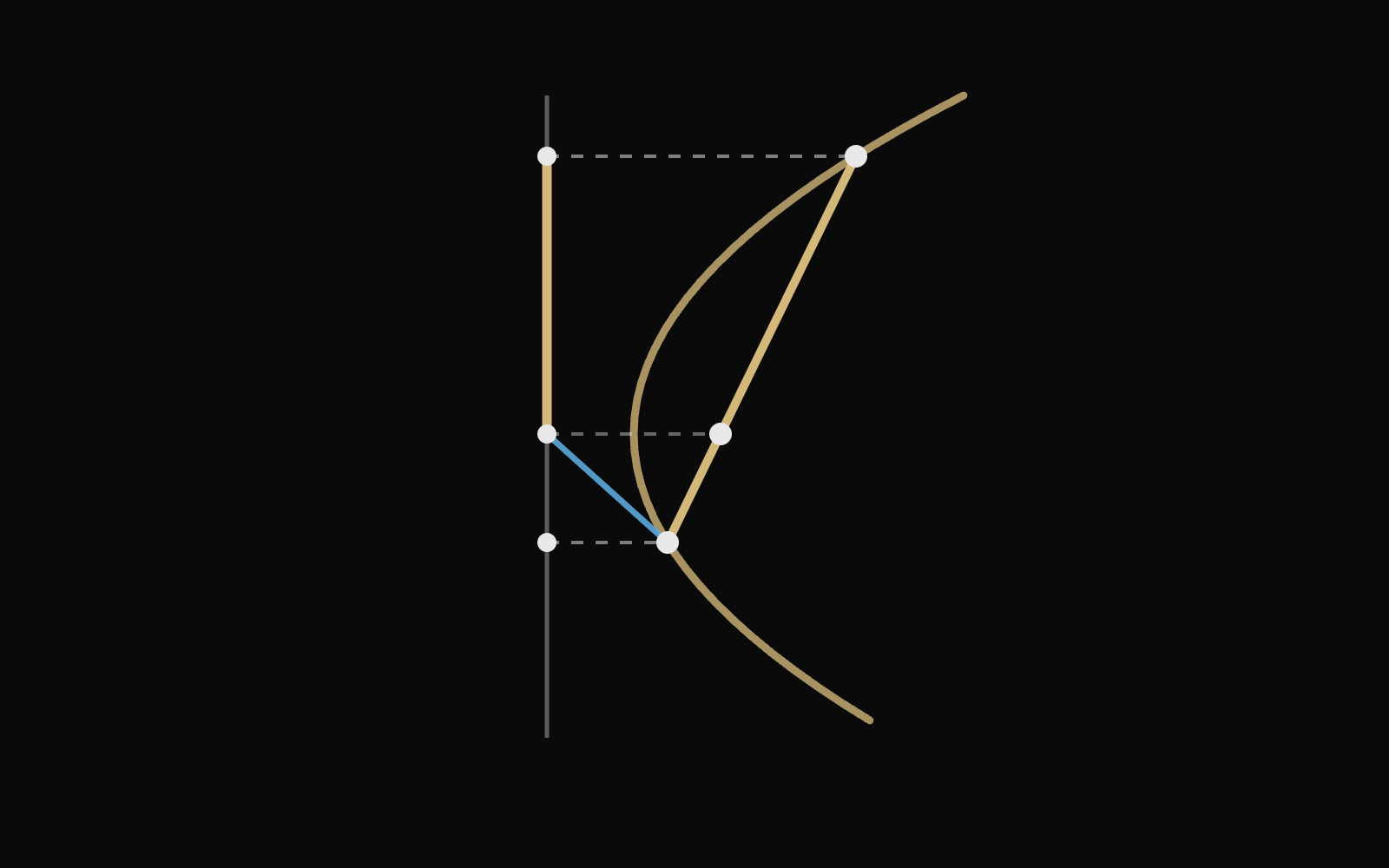
111 AST Mathematics I, Multiple select 7: equal lengths from the definition of a parabola, and the right triangles from the projections, identify one and the same segment ratio.
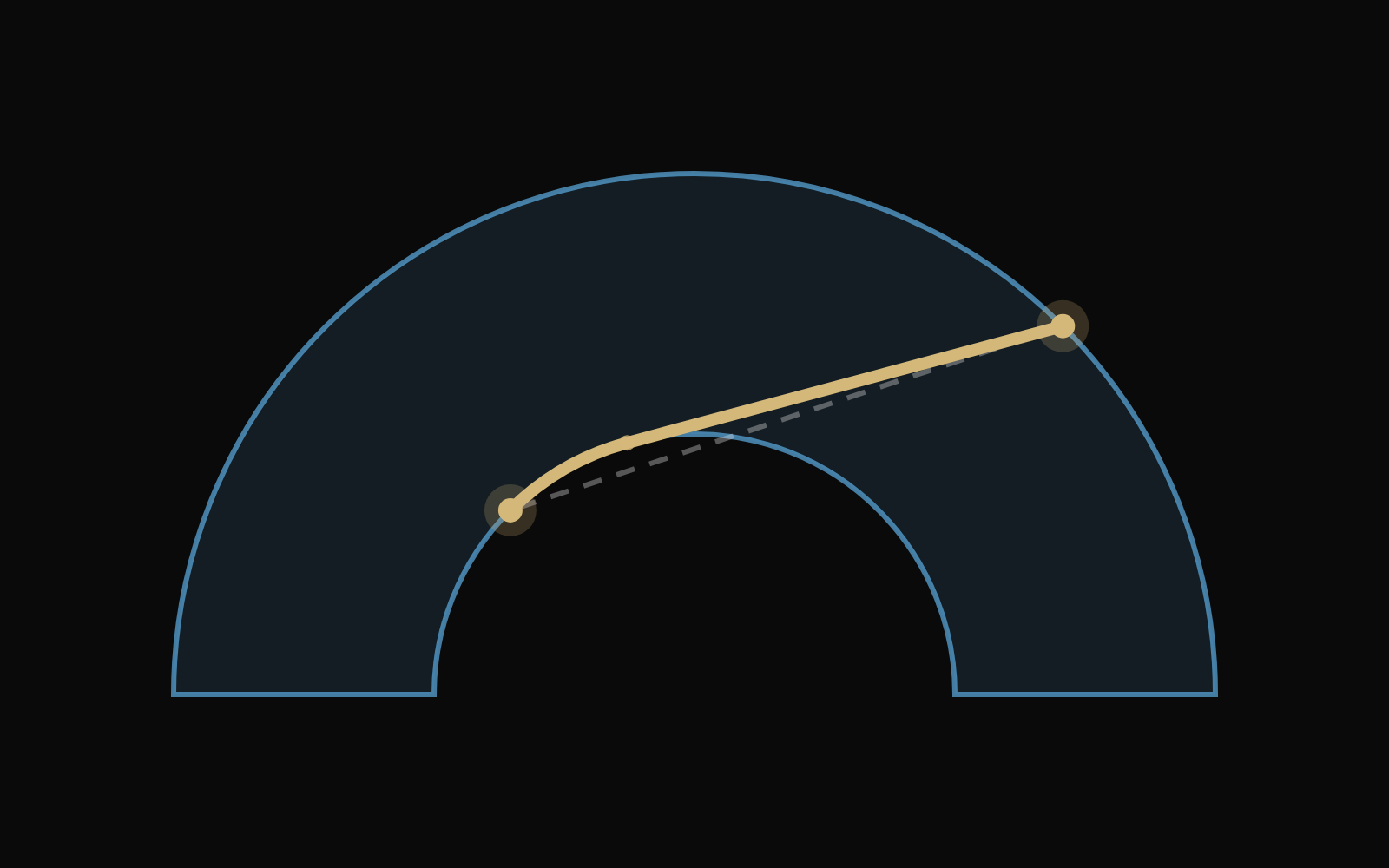
2023 AMC 12B, Problem #21 unfolds the shade into a half-annulus, where the straight line leaves the paper and the shortest path is a tangent plus an inner arc.