Complex numbers and Euler's formula
One rotation, read as complex multiplication, a point on the unit circle, and the cosine and sine of the same angle.
9 pieces about this concept, across works, topic guides, and exam visualizations.
Two rotating phasors join head to tail, and their sum traces how harmonic waves superpose as amplitude, frequency ratio, and phase difference change.
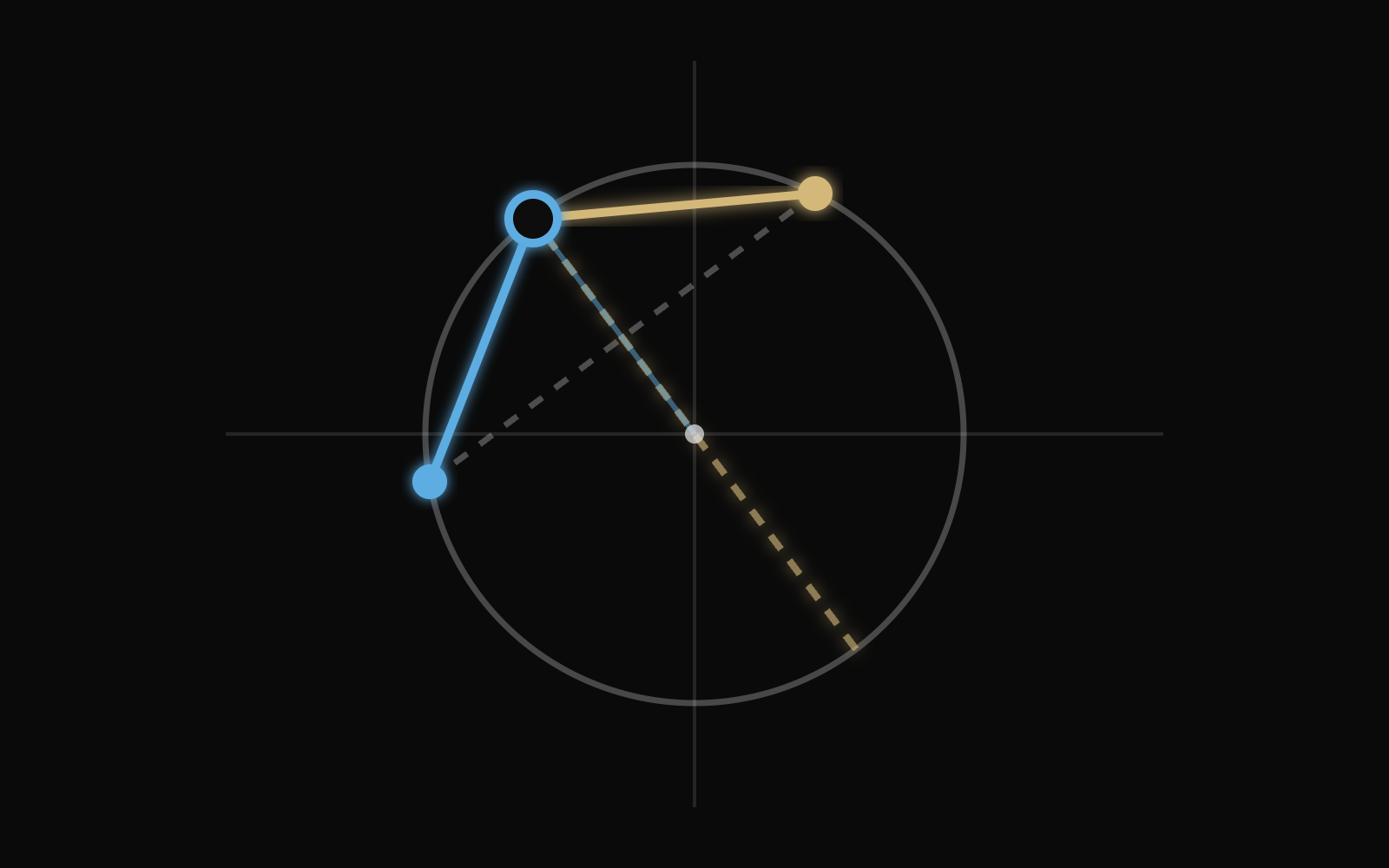
On the complex plane, addition combines vectors, and multiplication scales by the moduli and rotates by the sum of the arguments.
Any nonzero complex number is written as z = re^(iθ), with modulus r and argument θ, linking rectangular and polar coordinates.
Euler's formula e^(iθ) = cos θ + i sin θ rotates a vector on the complex plane and traces the sine wave of its imaginary part.
Iterating z to z squared plus c on the complex plane draws a fractal boundary and its self-similar structure.
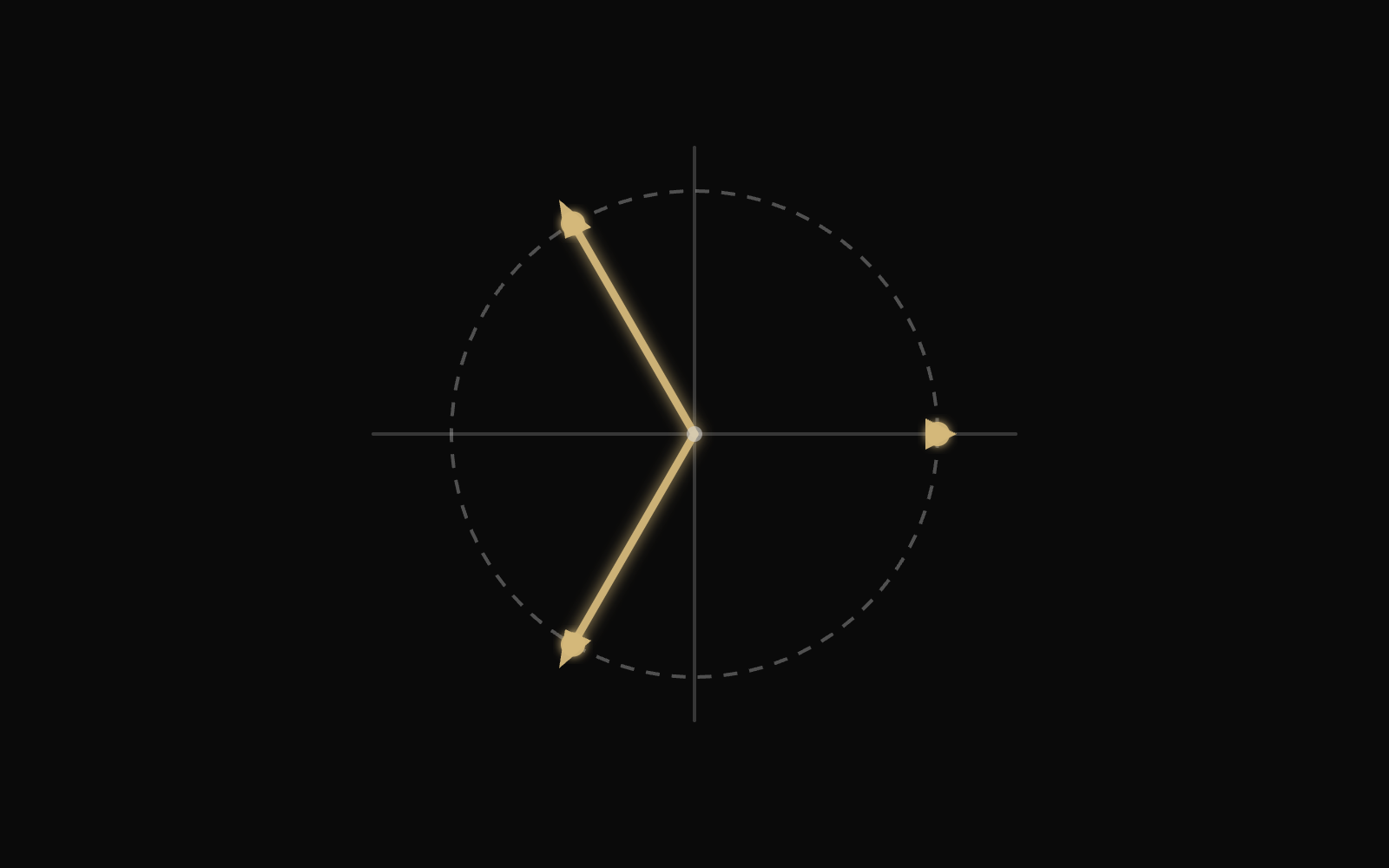
Drag a complex number z and watch a power multiply the argument by n, or roots divide the circle into n equal parts.